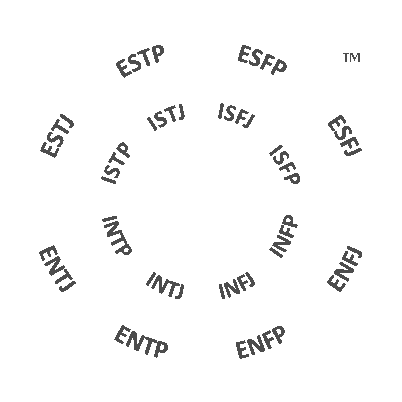
The Mandala (example right), that is used to present the results of our careers research, is based on Jung's model of Psychological Types.
History of Development
In 1921 Jung published a theory which identified some important ‘mental muscles’ that people use in everyday life.
During the mid 20th century, a mother and daughter team of Katherine Briggs and Isabel-Briggs Myers used Jung’s ideas to develop the Myers-Briggs Type Indicator® - a questionnaire that helps you identify which mental muscles you prefer.
The MTR-i® (Management Team Roles - indicator) is a further adaptation of Jung’s theory developed in the second half of the 1990s by Steve Myers (no relation to Isable Briggs-Myers) that helps you identify which mental muscles you are using most in a work/team setting.
Preference and usage
The difference between preference and usage of mental muscles can be illustrated by writing your name with your preferred hand, and then writing it again with your other hand. This usually shows that you have a clear preference for one hand, as writing with your preferred hand is much easier and quicker, and the result looks more 'grown up'.
But for many everyday tasks - such as eating a meal, driving a car, or playing golf - you use both hands. And the hand you use to steer whilst driving is not necessarily your preferred hand - it depends whether the car is designed to be left or right hand drive.
In a similar way, you probably have a preference for certain mental muscles, but you use all of them. The MTR-i questionnaire helps you identify which mental muscles you are currently using most, which may be different from your preference. It therefore indicates what type of contribution you are making to your work team.

The Mandala Construction
The mandala shows the four mental muscles that Jung identified, each of which can be used in two directions.
Sensing, denoted by the letter S, is used to shapes things or information to reflect known experience: taking action to produce tangible outcomes, or clarifying information so that it can be more clearly understood.
Intuition, denoted by the letter N, is used to uncover new potential in things, people or ideas: changing the way things are done to see if something new and better can be found, or dreaming up new, innovative ideas.
Sensing and Intuition are, to some degree, 'opposed'. That is, they work towards different things: eg: Sensing focuses on what is tangible and real, and Intuition focuses on hidden possibilities. It is normal for people to have a preference for one over the other, that is to find one style of working more comfortable and natural.
Thinking, denoted by the letter T, is used to introduce a logical structure into the team’s work or analysis: systematising the way things are done, or producing mental models that explain how the world works.
Feeling, denoted by the letter F, is used to assign value to people, things, ideas or information: building harmony and team spirit, or stressing the importance of certain ideas or beliefs.
Thinking and Feeling are also, to some degree, 'opposed'. Thinking focuses on impersonal considerations, tending to take a professional approach focused on structures and processes. Feeling focuses on personal values, tending to take an approach focused on interpersonal relations.
Each of these mental muscles can be used in one of two ways. Both ways involve creating, changing or achieving things, but that change or achievement takes place in one of two worlds:
- the outer world of people and things (Extraversion, denoted by the letter E)
- the inner world of ideas and information (Introversion, denoted by the letter I)
Extraversion and Introversion are also, to some extent, 'opposed'. Extraversion tends to focus on action and interaction, whereas Introversion focuses on thought and reflection.
Eight behavioural styles
The combination of the four functions and two directions results in eight behavioural styles, which are described in the MTR-i system using the following role names:
| Fe | Coach |
| Fi | Campaigner |
| Ne | Explorer |
| Ni | Innovator |
| Se | Sculptor |
| Si | Curator |
| Te | Conductor |
| Ti | Scientist |
We all use all of these styles/roles, but to differing degrees. Our comfort with the styles can also vary - some people are comfortable only with 2 or 3 styles, others feel they can move around the wheel more freely.

Personality Type Code
Your personality type code (eg: ESFP, INFJ) indicates where on the wheel you prefer to operate.
If you use a behavioural style that is on another part of the wheel to where you prefer, then this is role stretch. All careers will require you to stretch - to use non-preferred behaviours - to some degree. However, some careers may allow you to spend a lot of time in your preferred areas whilst others may require you to be very flexible and use a wide range of behavioural styles.
Career choice
If you want to choose a career that suits your personality, then you need to make sure that you are comfortable with the main behavioural styles in that career - ie the ones that will be used most frequently.
Our research shows which behavioural styles are used most frequently in the careers covered by the study. Please note that these research results should not be regarded as definitive as the study only covered 1,300 people, and there may be great individual variations between individuals, companies, cultures and countries in the styles actually used.