Home Business Leadership Management Team Building Team Roles Careers Myers Briggs Contact/Search      
Press   <Ctrl> +   to increase the size of text (using a modern browser)
Team Technology Logo

Leadership Styles

This article not what you are looking for? Try these...

leadership questionnaire

checklist of leadership qualities

Leadership styles

Based on Myers Briggs/Jung Typology

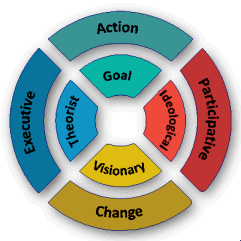
This page describes a popular model of leadership styles that can be used as the basis for leadership training or individual coaching.

These leadership styles are based on Carl Jung's eight psychological types and so are related to Myers Briggs preferences.

This model assumes that a modern leader will:

You can look at leadership styles from one of two perspectives.

The first is to ask what is my leadership style? This is to focus on what you enjoy, what you might be good at, what strengths and weaknesses you have. The second is to ask what leadership style is best for the people, team or organisation that I'm leading? This is to focus on the needs of the situation, on the criteria for success, on the approach that will bring about the maximum impact.

Modern leadership demands both. You need to recognise your own strengths and exploit them, but you also need to have an ability to adapt your style to different situations in order to achieve the maximum effectiveness. Rather than using solely one's own preferred style, excellent leaders are able to take different approaches to suit the various needs of differing circumstances, whilst also making sure that their own needs are met.

The table below describes each of the styles, and gives examples when the style should or should not be used.


LEADERSHIP STYLE
Myers Briggs type, Jungian type, MTR-i team role
Description When to use When not to use


PARTICIPATIVE LEADERSHIP
ESFJ/ENFJ, Extraverted Feeling (Jung), or Harmonising (MTR-i)
People-oriented, motivator, builds personal relationships, likeable, interpersonal skills, cares for others Commitment from others is critical, or sensitive situations Decisions need to be forced through, conflict is being avoided


IDEOLOGICAL LEADERSHIP
ISFP/INFP, Introverted Feeling (Jung), or Campaigning (MTR-i)
Value-driven, has passion for key issues, focuses on important themes, champions the cause The group has lost its sense of identity, or it is doing too many unimportant things There is a problem that needs to be solved with dispassionate objectivity (eg: technical issues)


CHANGE-ORIENTED LEADERSHIP
ENTP/ENFP, Extraverted Intuition (Jung), or Exploring (MTR-i)
Tries things that are new, prototypes, introduces change, looks for unexpected outcomes, creates new opportunities, experiments The group is 'stuck in a rut', or the status quo needs to be challenged There are already too many initiatives under way and some stability is needed


VISIONARY LEADERSHIP
INTJ/INFJ, Introverted Intuition (Jung), or Innovating (MTR-i)
Develops long term vision, produces radical ideas, foresees the future, anticipates what is outside current knowledge Radical change is needed, change is a long term activity There are immediate dangers, the group may not survive in the short term


ACTION-ORIENTED LEADERSHIP
ESTP/ESFP, Extraverted Sensing (Jung), or Activating (MTR-i)
Takes action, produces results, leads from the front, sets an example, does what is asked of others There is some inertia, or lack of achievement has destroyed motivation The group is being too expedient, current success may ebb in the future


GOAL-ORIENTED LEADERSHIP
ISTJ/ISFJ, Introverted Sensing (Jung), or Clarifying (MTR-i)
Observes, listens, clarifies goals, establishes realistic expectations, makes aims crystal clear The direction is vague or expectations have not been articulated There are already too many goals or too much information


EXECUTIVE LEADERSHIP
ESTJ/ENTJ, Extraverted Thinking (Jung), or Conducting (MTR-i)
Organises, makes plans, sets measurable goals, coordinates work of different people, manages resources There is chaos/lack of organisation, or there are no measures of achievement There are so many processes that creativity has been stifled


LEADERSHIP THEORIST
ISTP/INTP, Introverted Thinking (Jung), or Analysing (MTR-i)
Analyses, uses models, produces explanations, compares other situations, engages in intellectual debate The situation is complex or driven by technical solutions People's feelings are paramount, or the group go round in circular arguments

This model of leadership styles can be used to increase the effectiveness of a leader. The key to success is developing the external awareness of what is required, and the internal flexibility to be able to access each style as appropriate.

Discover your natural leadership style and qualities

Complete the leadership styles questionnaire